Loyal, loving, funny, fierce, and full of heart, dogs have been eternal muses across centuries and cultures. In honour of WOOF! The Dog Show and our four-legged companions, this blog takes a short (but spirited!) look through the long, tail-wagging history of dogs in art.


Prehistoric Pups and Ancient Guardians


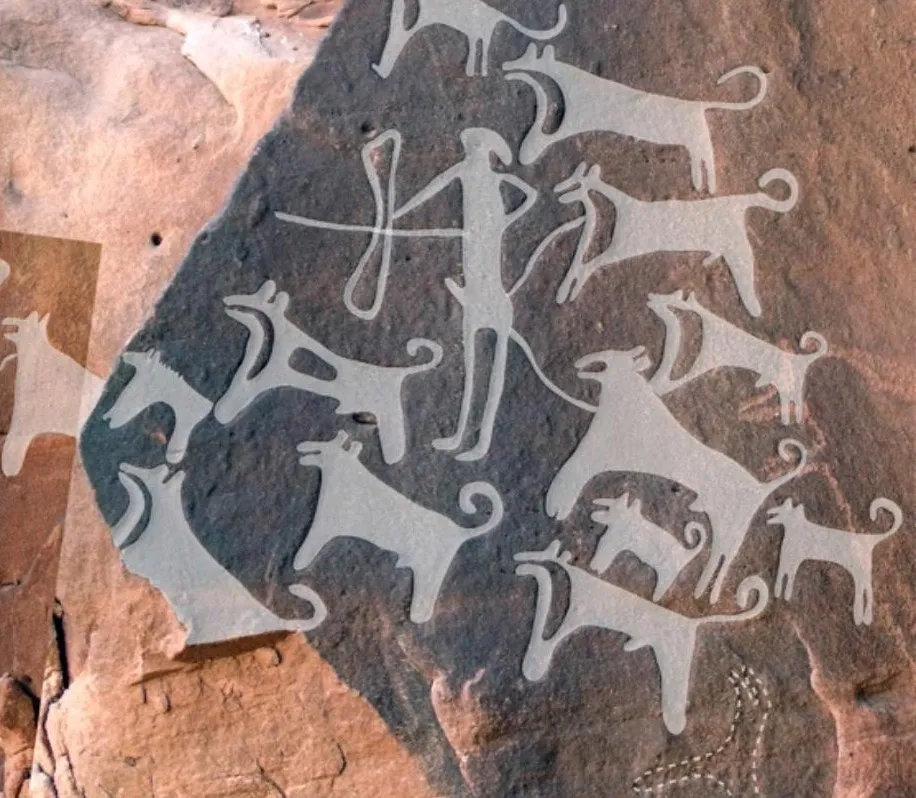
Artistic depictions of dogs can be traced back around 8,000 years. Rock paintings and carvings found in the Sahara Desert, Saudi Arabia, and India show dogs, leashed and not, alongside humans. In Ancient Egypt, dogs were spiritual protectors, appearing in tomb art and representing loyalty, protection, and guidance into the next world. The god Anubis, with the head of a jackal or dog, was the guardian of the dead and a key figure in the afterlife.


Composite image of rock art found in Saudi Arabia depicting two scenes: on the right, a hunter with 13 dogs and possible leashes from his waist; on the left, a hunter with a large equid and eight dogs. The top image highlights the engravings outlined in white. Image credit: Journal of Anthropological Archaeology/Maria Guagnin/Max Planck Institute for the Science of Human History


Classical Companions


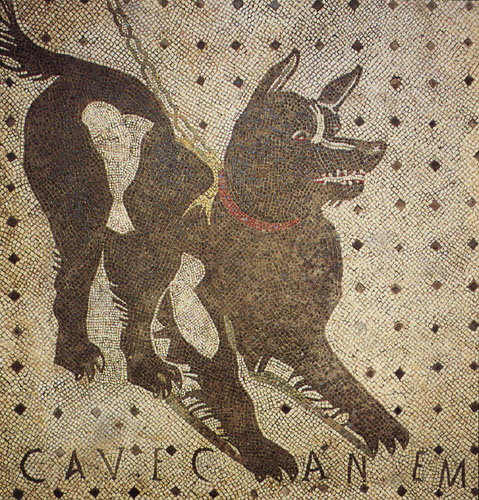
In Ancient Greece and Rome, dogs were depicted as icons of fierceness, fidelity, and domestic loyalty. Roman villas and tombs often included depictions of dogs guarding humans in life and death. A famous example of this is the Cave Canem mosaic originally at the entrance of the House of the Tragic Poet in Pompeii, featuring a collared dog with the warning to visitors,Beware of the Dog”. In Ancient China, terracotta tomb figures often included dogs, depicted as playful companions and fierce protectors of nobles and soldiers.


Cave Canem, “Beware of the Dog”. Image credit: What Life Was Like: When Rome Ruled the World: The Roman Empire, 100 BC-AD 200 (1997) by the Editors of Time-Life Books


Medieval Man’s Best Friend, Renaissance Runners, and Philosophical Fidos


By the Middle Ages, dogs were common in European art, symbolising loyalty, devotion, and status. Small breeds appeared in formal portraits, like Rogier van der Weyden’s Portrait of a Lady (c. 1460) and everyday scenes like Jan van Eyck’s The Arnolfini Portrait (1434). More than decorative companions, these dogs acted as visual guides, often gazing straight at the viewer, hinting at deeper moral or emotional themes.


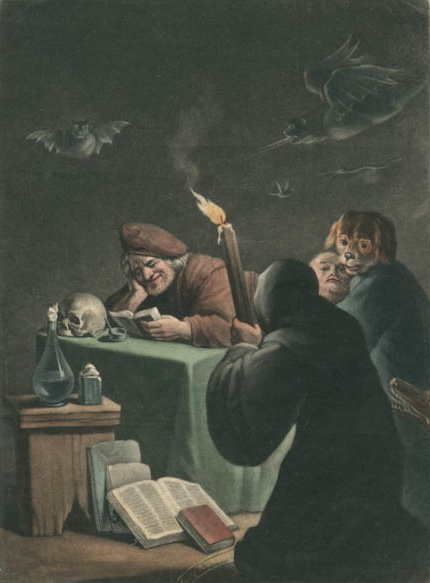
During the Renaissance, dogs became symbols of nobility and courage, with the Talbot Hound becoming a regular figure in family crests. By the 16th and 17th centuries, dogs took on philosophical positions, as in David Teniers the Younger’s Old Master, Philosopher Laughing at Magick (1775), where a dog-headed man stands behind a philosopher, embracing a human head, offering a symbolic reflection of philosophical practice in the time of Enlightenment.  Beyond Europe, dogs featured in Japanese netsuke and Chinese decorative arts as signs of family, protection, and prosperity.


Philosopher Laughing at Magick (1775), David Teniers the Younger. Image credit: https://www.georgeglazer.com/


Victorian Dog Portraits & Early Modern Musings


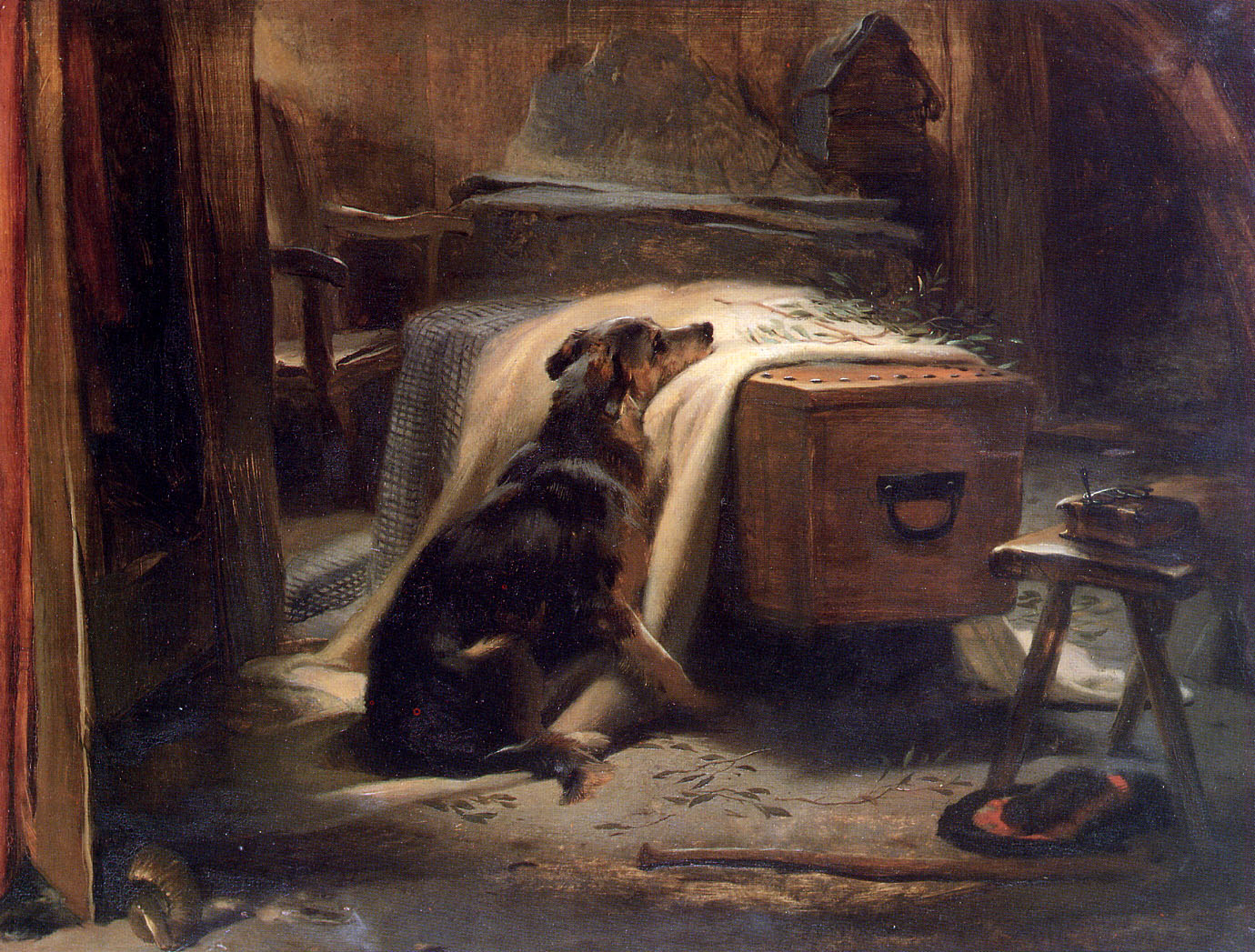
In the Victorian era, dogs took centre stage as main subjects, not just companions. With the Kennel Club’s rise in the UK (1873) and US (1884), breeds became standardised, and owners commissioned proud portraits. Artists like Dutch Otto Eerelman captured lifelike St. Bernards and mastiffs. British painters such as Arthur Wardle embraced sentimentality, as seen in The Totteridge XI (1897) with its poised fox terriers. Edwin Landseer presented dogs as emotionally complex subjects with works like The Old Shepherd’s Chief Mourner (1837), where a loyal dog mourning its master became a Victorian symbol of grief and devotion, showing dogs painted with human-like care and emotion.


The Old Shepherd’s Chief Mourner (1837), Edwin Landseer. Image credit: https://collections.vam.ac.uk/item/O16452/the-old-shepherds-chief-mourner-oil-painting-landseer-edwin-henry/


Modern & Contemporary Canines


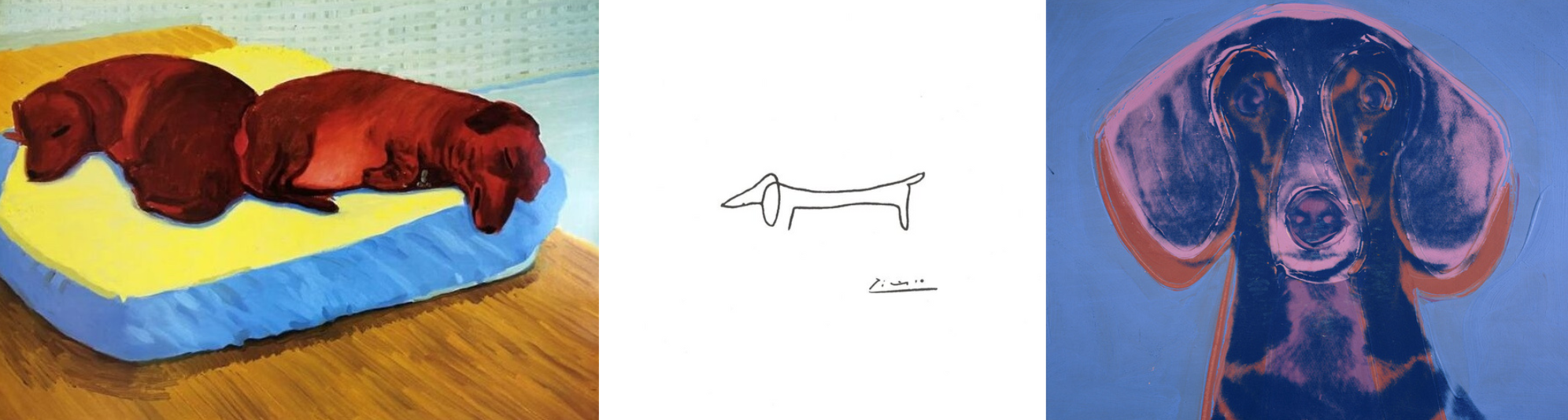
In modern and contemporary eras, dogs have stayed firmly in the frame, as companions and symbols of love, identity, and rebellion. Pablo Picasso famously adored his dachshund Lump, capturing him in the iconic Dog (1957), a minimalist line drawing that says everything in one stroke. Andy Warhol famously painted his dachshunds Archie and Amos with the same pop flair as Marilyn and soup cans, proving dogs could be pop icons. David Hockney’s Dog Days series (1995) is a tender tribute to his dachshunds, Stanley and Boodgie, capturing everyday affection. Hockney said it best: The subject wasn’t dogs but my love of the little creatures.


From left to right: Dog Painting 38 (1995), David Hockney; The Dog (1957), Pablo Picasso; Portrait of Maurice (1976), Andy Warhol. Image credit from left to right: https://www.afficheon.com/products/david-hockney-dog-painting-38-1995-offset-lithograph, https://www.artsy.net/artwork/pablo-picasso-the-dog-small, https://www.nationalgalleries.org/art-and-artists/41712.


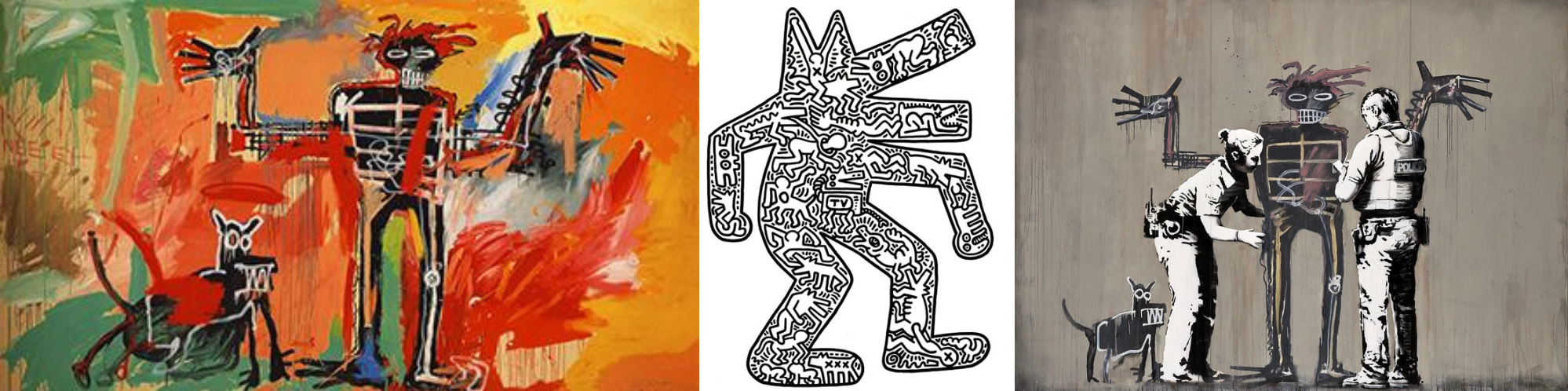
Artists like Jean-Michel Basquiat and Keith Haring turned dogs into powerful motifs. Raw and chaotic, Basquiat’s Boy and Dog in a Johnnypump (1982) became one of the most valuable paintings ever sold. In Banksy’s tribute to Basquiat, Boy and Dog in Stop and Search, the dog symbolises innocence under political pressure. Keith Haring’s barking dogs are playful on the surface but arose from a place of activism and protest around the HIV/AIDS epidemic.


Left to right: Boy and Dog in a Johnnypump (1982), Jean-Michel Basquiat; Dog (1985), Keith Haring; Banksquiat. Boy and Dog in Stop and Search (2018), Banksy. Image credit from left to right: https://www.jean-michel-basquiat.org/boy-and-dog-in-a-johnnypump/, https://www.haring.com/!/art-work/758, https://banksyexplained.com/banksquiat-boy-and-dog-in-stop-and-search-2018/.


WOOF! The Dog Show at Morningside Gallery – A Tribute to Dogs in Contemporary Scottish Art


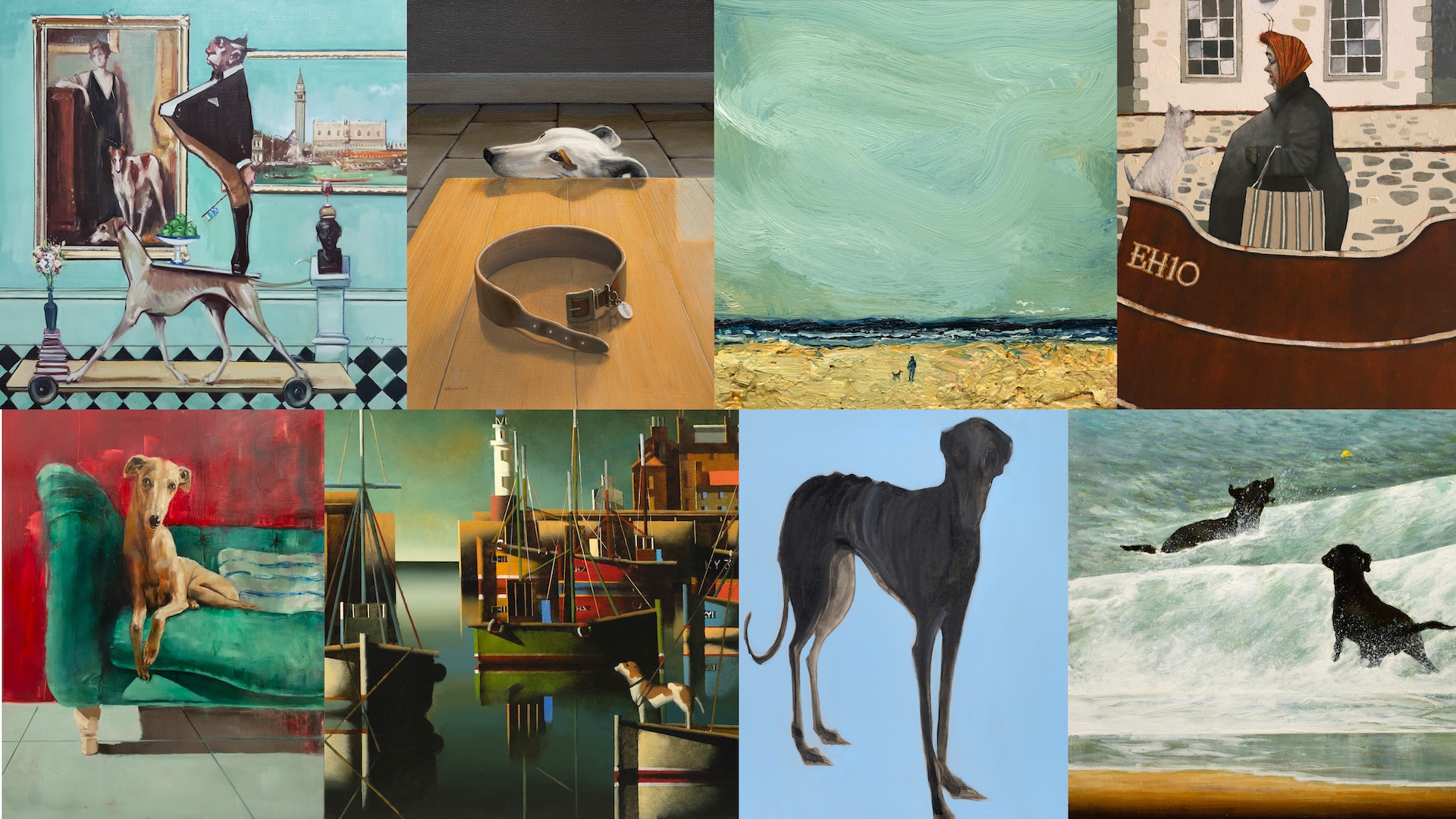
Today, dogs remain beloved furry muse, full of heart, meaning, and memory. WOOF! The Dog Show is Morningside Gallery’s celebration of dogs’ timeless charm through the lens of contemporary Scottish art. This joyful exhibition showcases how dog paintings continue to thrive, capturing everything we love about our four-legged friends: loyalty, warmth, mischief, and unmistakable woofs.

We’re proud to showcase an outstanding line-up of artists: Joe Hargan, Gordon Mitchell, Louis Sinclair McNally, Stephen Mangan, Gemma Rees, Hilke Macintyre, Gordon Wilson, Catherine Rayner, Helen Fay, Morag Muir, Denise Findlay, Lesley McLaren, Sally Muir, Richard Twose, Fiona MacRae, Brian Henderson, Stuart Buchanan, Iain Holman, Georgina McMaster, David Smith, Joyce Gunn Cairns, and James Tweedie. Each brings a heartfelt and distinctive approach to celebrating dogs in their work.

Join us in honouring the timeless bond between people and pups through this vibrant collection of contemporary Scottish dog paintings, a warm and whimsical homage to man’s best friend.


Image credit: Morningside Gallery

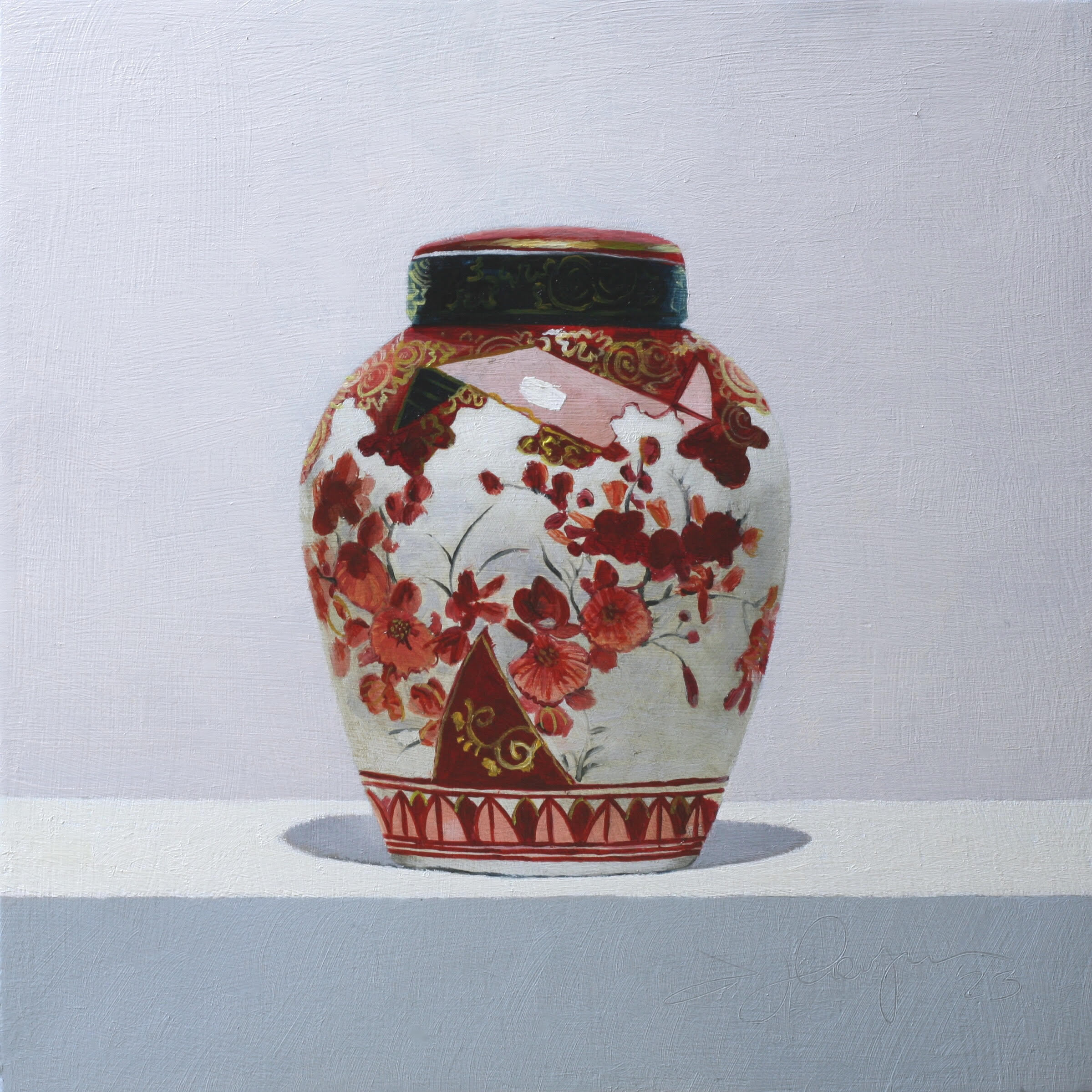
Our Mixed Spring Exhibition features many of our regular exhibiting artists, alongside returning artists Morag Muir PAI RSW, and Ann Wegmuller RSW RWS. You’ll find springs finest flowers from Marion Drummond PAI, George Birrell’s jewel like harbour scenes and Andrew Thompson’s exquisite paintings of Qing Pottery.


Andrew studied painting at Glasgow School of Art and graduated in 1997. He now lives and works on the Black Isle in the Highlands of Scotland. His work can be found in many private collections, including the collection of HRH The Duchess of Rothesay. Andrew paints a wide range of still life subjects and this latest collection of paintings features his flower and fruit studies, along with a number of exquisitely painted Chinese ceramics and silverware.


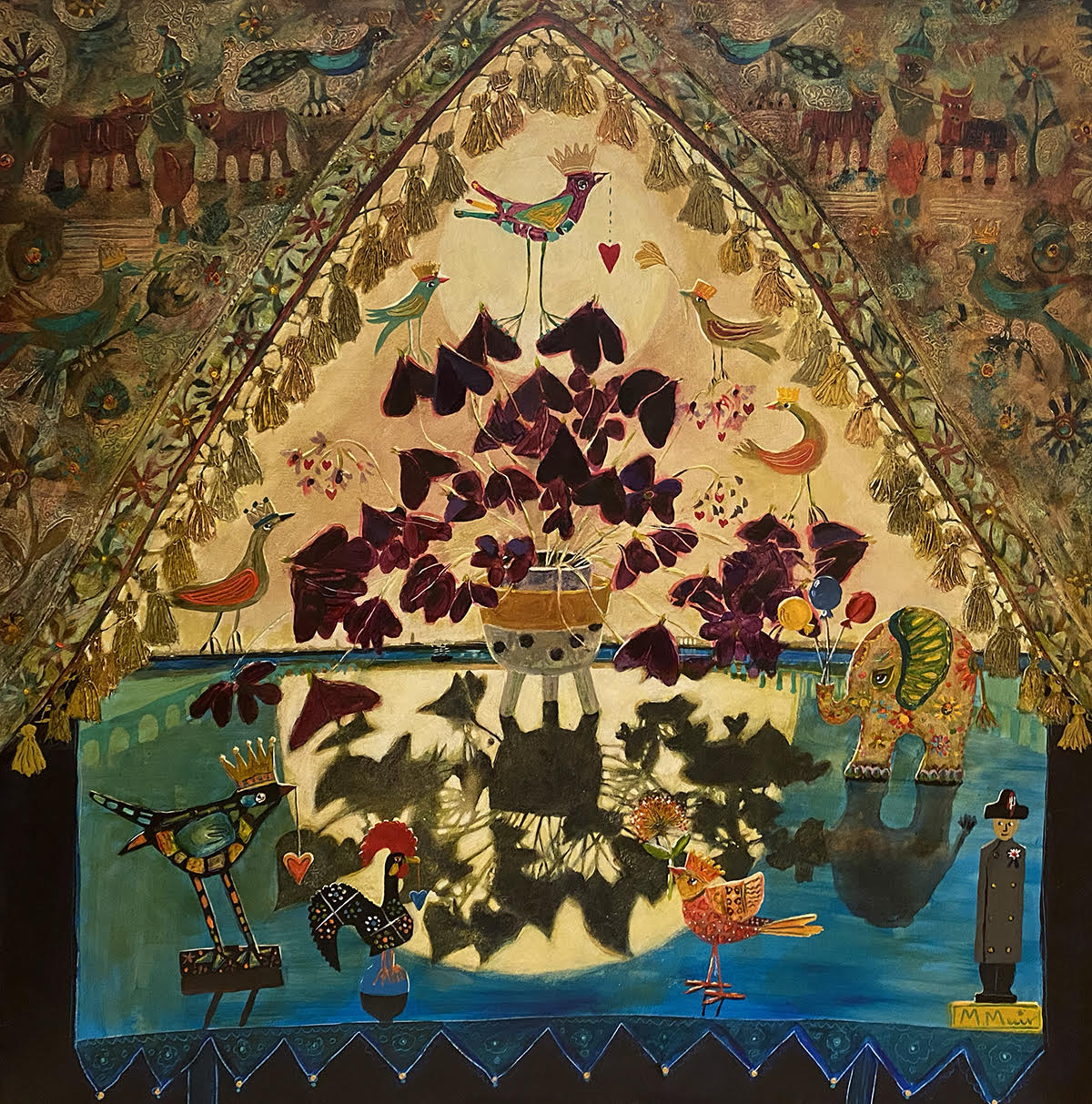
We are delighted to be exhibiting Morag Muir’s paintings once again! Morag was born in Glasgow and studied Fine Art at Duncan of Jordanstone College of Art & Design, Dundee from 1978-1982. She completed a year of postgraduate study in 1983, winning the John Milne Purvis Prize and the Major Travelling Scholarship, which financed further study in Italy. Morag works from her studio in Newport-on-Tay in Fife, Scotland which has beautiful views across the Firth of Tay. Her paintings mainly reflect the studio environment, and her still-life work incorporates narratives that develop when characters and objects begin to populate the canvas. Windows, flowers, textiles, toys and ethnic bric-a-brac share ambiguous spaces.


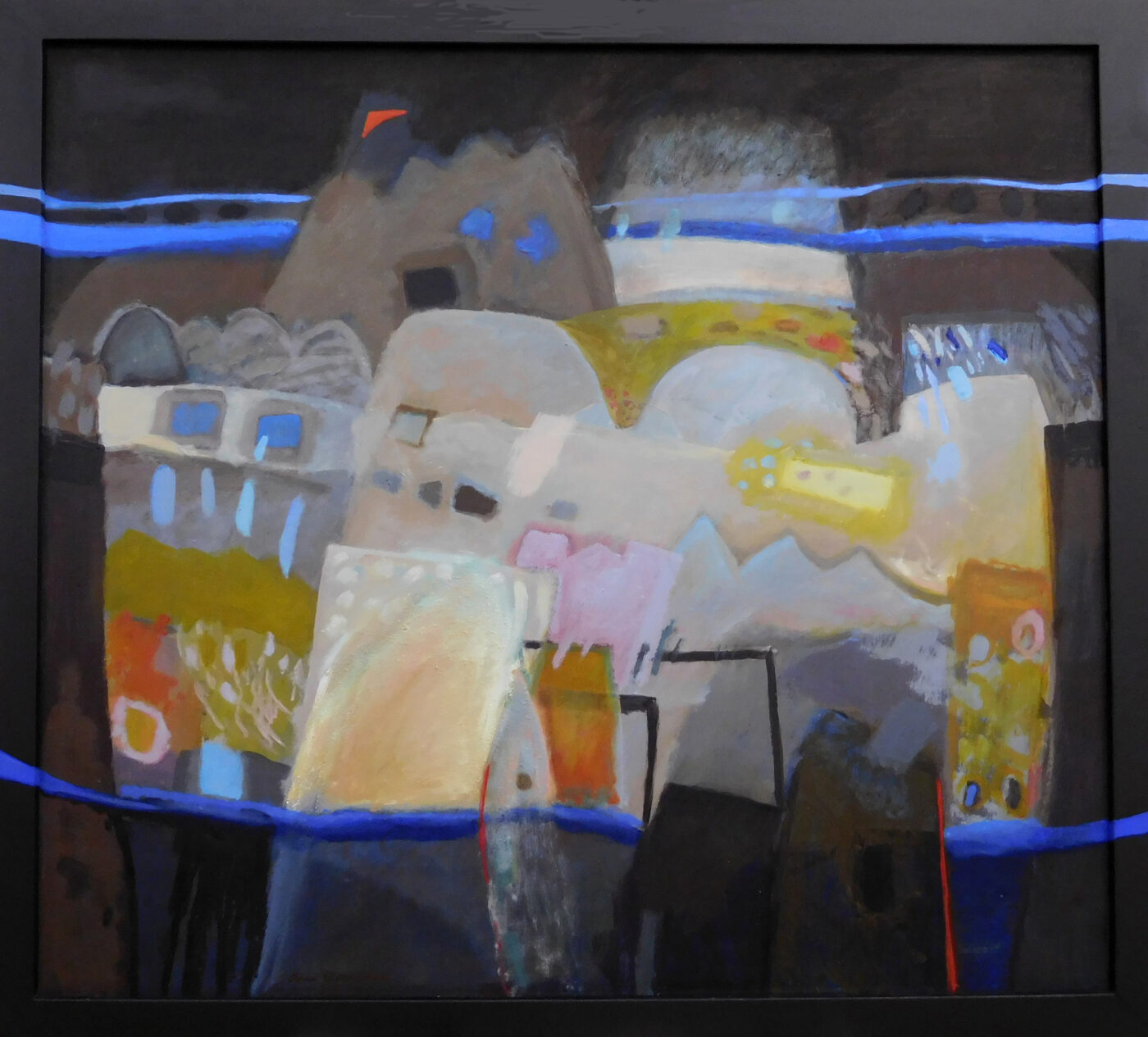
Ann Wegmuller RSW RWS is known for her bold use of colour and evocative, semi abstract compositions. In many ways colour is the real subject of Ann’s paintings and the paintings themselves start from her feeling for a place. It is like music: different sounds are like different colours, and each colour has its own beauty and strength but can be enhanced or toned down by another colour.


6th – 31st March

CONTACT US

JOE  HARGAN PAI PPAI

WINTER  EXHIBITION 2021

I trained in drawing and painting at Glasgow school of art under Dr David Donaldson, Queens Limner in Scotland. Glasgow was well known for its draughtsmanship, use of paint, with a heritage of the Glasgow boys and Scottish colourists; George Henry, Hornel, Peploe, Hunter, Ferguson, and others… The colour was prime. I work in several varied approaches from representational to abstract works. The pieces at Morningside Gallery mainly show the “Sniffy “series that have been highly appreciated and enjoyed. The smaller works, the girls heads often become characters in the larger works the Sniffy scenarios.

This began by sheer luck, it was simply one piece sent to the Royal Academy of Arts in London, around the Millennium. It sold at the private view, and I was approached by several people by letter and phone calls requesting if I had others. Thus began a popular series, which I refer to as ‘Little Playlets’ where ‘Sniffy’ is the main character with his trusty friends, his pet dog or cat. He is often displayed against paintings and works of art I much admire or even poke fun at. The titles are carefully chosen to stir a laugh in the viewer through pun.

The Awakening

The paintings in the background are my versions of an artist I much admire: Canaletto, the ‘Clock Tower’ and the library St Mark’s Square, Venice. Often, I play with contrasting artistic devices i.e. Traditional paintings v Conceptual floor arrangements. Here we see ‘Sniffy’ lying prostrate on the floor, out for the count after a session of drink. He acts as a human sculpture and commentator. Here you see several wine glasses, arranged alongside his sleeping body, another in waiting on the mantelpiece. The wine symbolises the fruits and the good things in life. Awaiting ‘the awakening’ of the master for the twitching of his nose are his trusty pets in anticipation of food or a walk. They monitor his condition with incredulity at his silliness.

Who Dunnit

The background pictures are my still life works including a love token the ‘Ace of Hearts’ card. This is part of the Sniffy series although he is not present but is represented by his daughter reprimanding the dog. She has been seen in other scenarios as the little dancer representing creativity, youth, joy, and energy.  It is not obvious what the dog has done, has he eaten or played with one of the apples? Nonetheless the response of the dog is to avoid eye contact as they often do when guilty — ‘It wisnae me!’

Training Session

The background painting is a Canaletto of St Mark’s Square, Venice. Here we see another member of the Sniffy family training the dog before playing with the treat in her hand. The dog remains resolute and undeterred by the temptations of cakes on the stand. Standing against the skirting is a token of love the Ace of Hearts’ The wine glass on the dog’s back emphasises his control but hints at the possible break in silence if it falls.

A  Little Rosey

The background paintings are my versions of Venice. Venice today around St Mark’s Square has little changed since the 18th century. The title of the work is a pun on the colouring of the painting, the wine and the name of the dog. Generally, a tongue in cheek painting where ‘each to their own’ have their preferences, Sniffy his wine, the dog a ball.  The ace of hearts is a symbol of their affection for each other.

Forty Winks

The traditional works in the background are by the American artist Singer Sargent. The young girl looks out towards the viewer, lost in thought, as she anticipates her letter. The whippet stands sculptural in profile on the plinth as a work of art. The items on the plinth are books for learning, the ubiquitous burger with flags hinting at past and future political history choices and the ace of hearts a love token reference. Sniffy lies deep in sleep hence title, ‘Forty Winks’.

Horse Play

‘Horse Play’ is the largest work in this suite of paintings and it humorously plays with the Canaletto double of the clock tower. This is a play on the old game of spot the difference. Sniffy lies in his favourite position on top of the piano, with a pile of books on his tummy, representing learning. Close by is a glass of wine, fruits of your labours with a reserve glass on the mantlepiece. The English shire horse leans in to complete a surrealist impact to the work.

The Sleeper

The paintings on the back wall are my works except for the central girl painting which is my adaptation of a Singer Sargent work. The young girl in the foreground looks out with a quizzical look. The black bronze figure struts its stuff on a white plinth. Sniffy makes a small appearance in sleeping mode to the right side of the work. Strewn around the floor are items, a pear with seeds, Fertility, playing cards, love life and death. The green apples on the plinth summer fruits of your labours. The work is completed by the lit candle in the empty hearth, a symbol of hope. Also, it is a tongue in cheek reference to the asset rich in property, barely affording to heat their pile.

Still Life

This green room displays three of my still life works in a fresh modern idiom. The central work is highlighted by my cat Jasmine who would often steal the show by her unwelcomed visit as she would walk across the still life arrangement. Sniffy and the dog stand in profile as sculptural elements. Sniffy is always seen in profile as a commentator figure and entertainer a hint at the human sculptural works of Gilbert and George. The items on the plinths, wine, fruits of your labours, apple, summer fertility and love token ace of hearts complete this fun and joyous work.